
Level 1 · App security controls
Checkout context is tied to store policy, customer action flow, and transaction state to reduce tampering risk.
Policy-aware flowContext integrityControlled actions
Security & Verification · Live rollout discipline
HosaFlow combines app-level control, verification-floor control, auditability, and payment-layer trust to protect store operations and customer confidence while self-checkout expands carefully.
3-level checkout security
Level 1 · App security controls
Checkout context is tied to store policy, customer action flow, and transaction state to reduce tampering risk.
Level 2 · Verification floor
Security/store staff scan purchase QR and manually verify item list + quantity before final exit handover.
Level 3 · Payment trust
Payments run through store-connected PCI-compliant gateways, aligning processing security with established payment standards.
Every self-checkout transaction is designed to pass through controlled checkpoints before store exit is approved.
Purchase captured
Customer checkout generates transaction context.
QR context ready
Purchase QR carries verification reference data.
Manual verification
Security team checks items and quantity physically.
Approved handover
Only verified purchases are cleared for exit.
Secure login + tamper checks
PIN-protected operator access and manual verification work together to reduce misuse, identify unpaid items, and keep handover decisions in store control.
PIN and secure-login layer protects sensitive operations and verification actions.
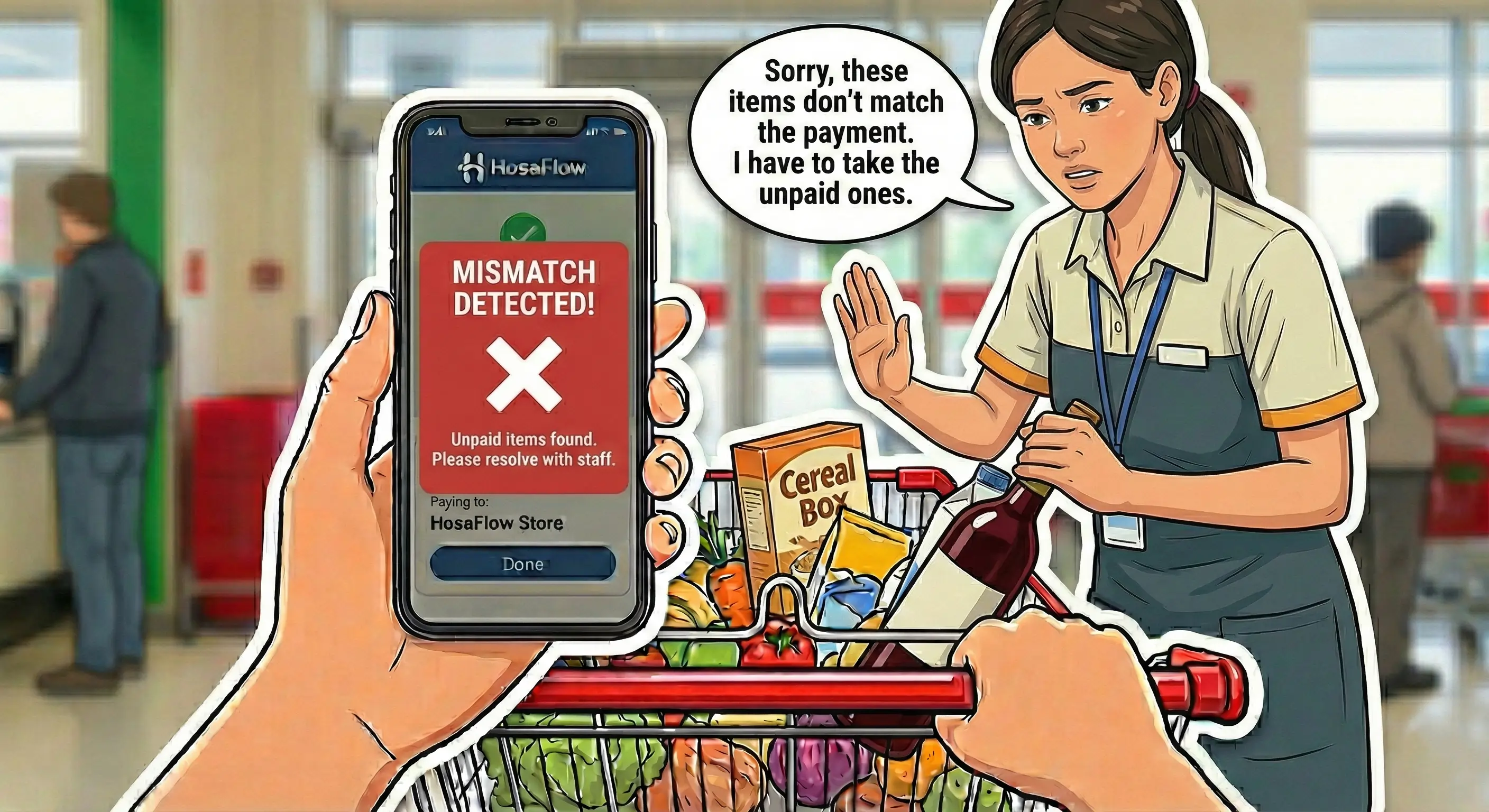
Manual verification finding
Security scan helps identify mismatch or unpaid product before final exit approval.

Audit and review checkpoint
Suspicious checkout behavior can be reviewed and audited with manual floor verification.
Security is not just one feature. It is enforced through configurable limits, role-scoped access, and operational verification discipline.
Every critical action is audit protected by role. If a security issue occurs, the event can be traced to who performed which action, when it happened, and what items were involved.
Owner role
Can review full verification logs, incident history, and escalation outcomes.
Manager role
Can monitor verification quality, review flagged sessions, and assign follow-up actions.
Security/staff role
Performs QR scan and item verification actions that are logged with actor identity and timestamp.
System audit layer
Preserves verification trail linking transaction context, scanned QR, verified items, and handover decision.
Example: a security staff member intentionally clears a known person with unpaid items. This can be detected and investigated using role-based audit history.
Exit action logged
Who scanned, when scanned, and which checkout context was approved are recorded.
Item mismatch trace
Audit compares verified item list against purchase context and highlights anomaly.
Role visibility
Owner/manager can see actor-level verification history and linked session details.
Escalation handling
Issue can be escalated, reviewed, and operational controls tightened for future prevention.
What can be seen in audit records
HosaFlow routes payment through store-configured gateways. Processing security is handled by actual PCI-compliant gateway providers and their compliance controls.
We can walk your team through verification checkpoints, tamper-resistance controls, governance limits, and payment trust architecture for your store format.